When to use Startup Pitch Deck template
This template is created by our team for startups looking for funding, primarily early stage, rather than series A or B. Later stage startups usually need a more detailed pitch about their financials, their growth, traction, customers, etc.
What is the purpose or goal of this pitch deck (i. e. the template)?
The ultimate goal of the pitch (using the deck) is to convince investors to invest in your startup. Usually you'll be sending the pitch deck to a lot of investors, while only a few usually respond. As a next step, you'll have some conversations with potential investors who show interest, while you keep refining the pitch deck based on the feedback you get. This way the pitch deck is a living document that is not only telling your story to investors, but also helping you structuring your thoughts about the strategy of your startup.
The slides of the pitch deck explained in detail.
Slide 1 - The title slide
The title slide needs to be eye catching and memorable. It should be a single sentence with the name and the essence of your startup.
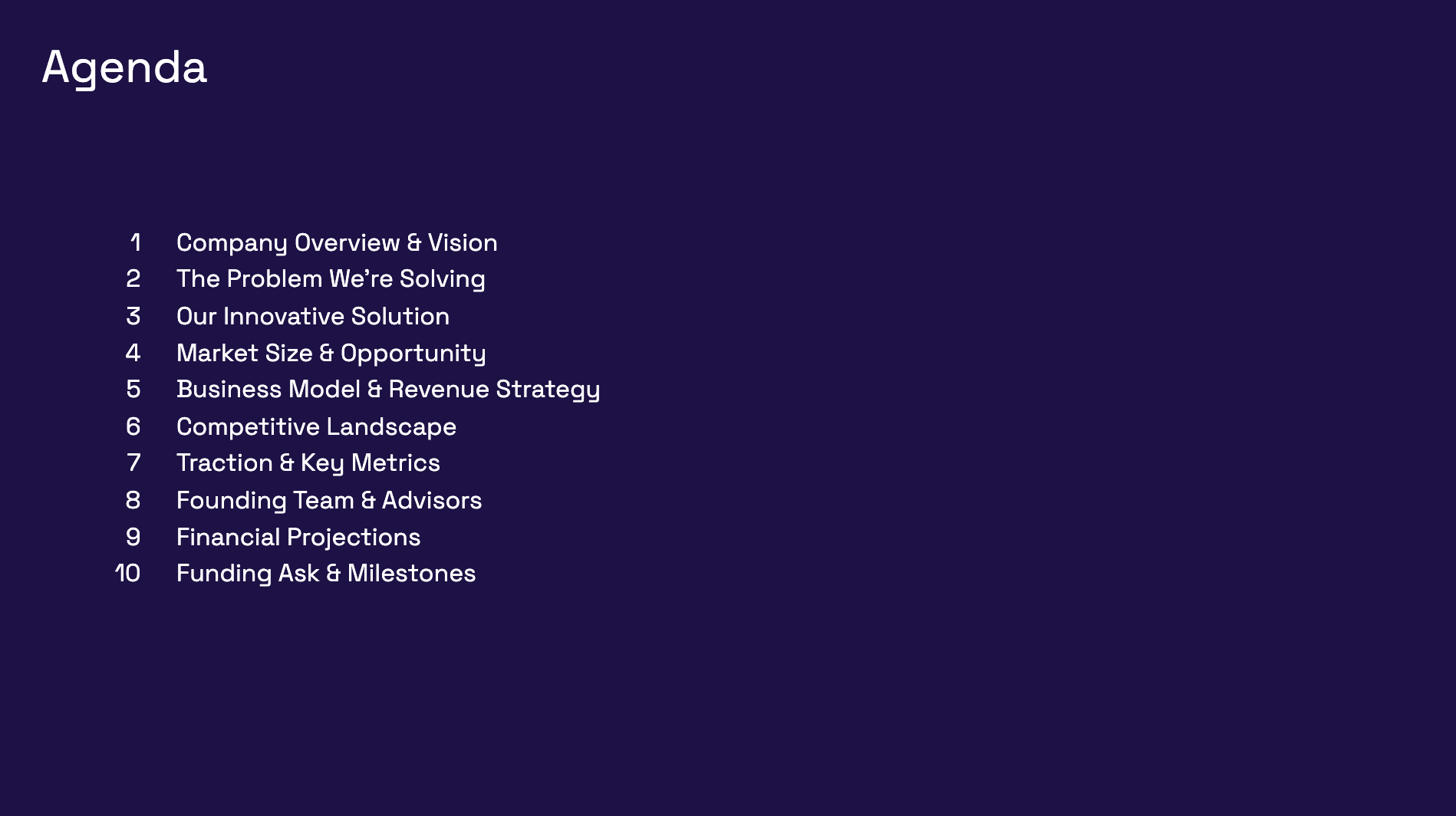
Slide 2 - The agenda slide
Potential investors will get a brief overview of what you'll be talking about in the presentation. They will understand immediately if your pitch contains all relevant information they need to know. They will also understand if you're organized and structured in your thinking.
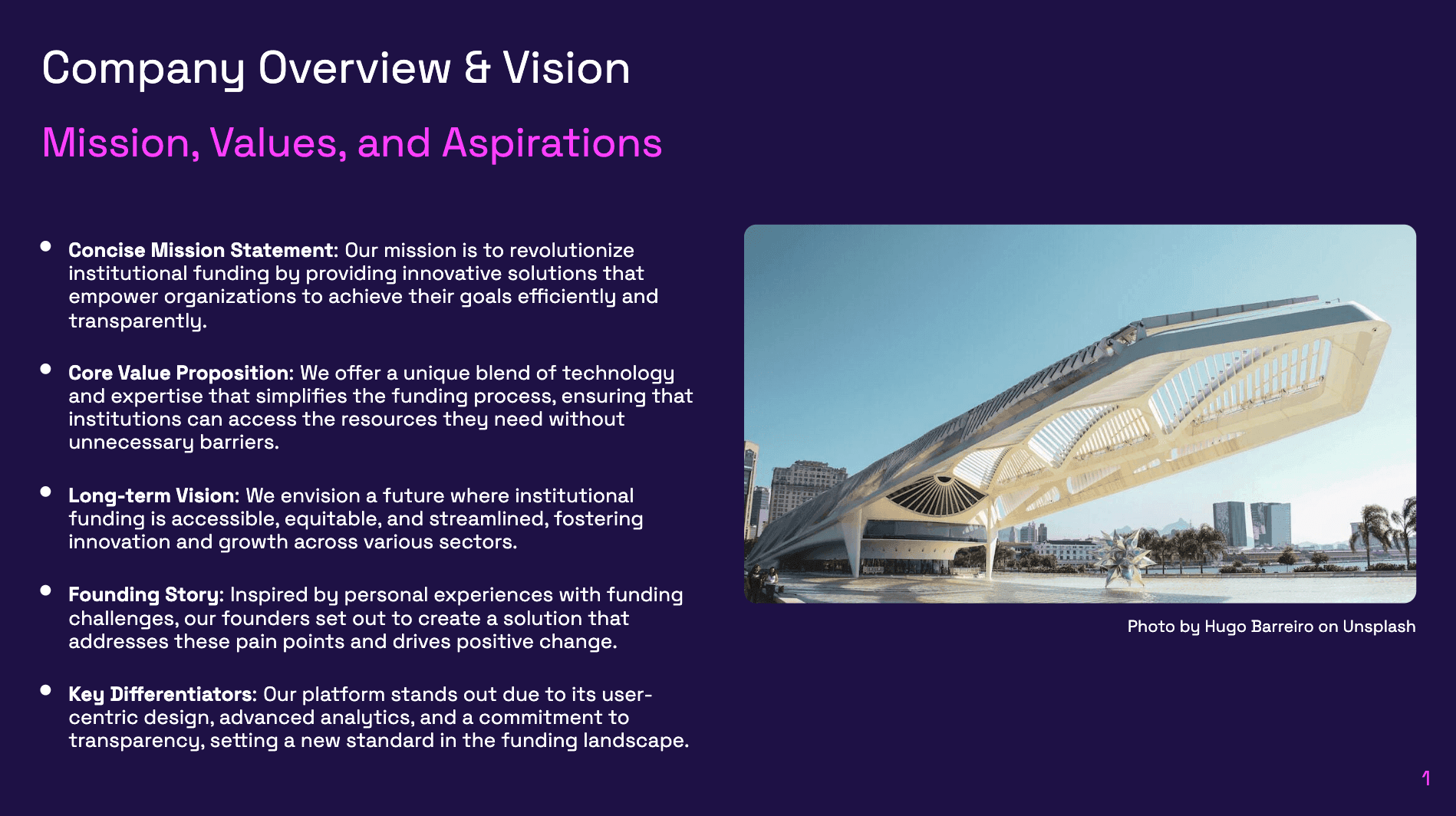
Slide 3 - Company Overview & Vision
A potential investor want to know very briefly what your startup is about, who you are and what your vision is. Investors usually want you to aim high and have a big vision for your startup, because they want to invest in a startup that has a big potential and 10x their investment. If you don't have a big vision, it's most likely that they will not invest in your startup because the expected return on investment might not be suitable for their investment goals. Usually you'd have a few short sentences about your mission, vision, and value proposition. But don't dive too deep into the details here, as you'll be diving deeper into these topics in the following slides.
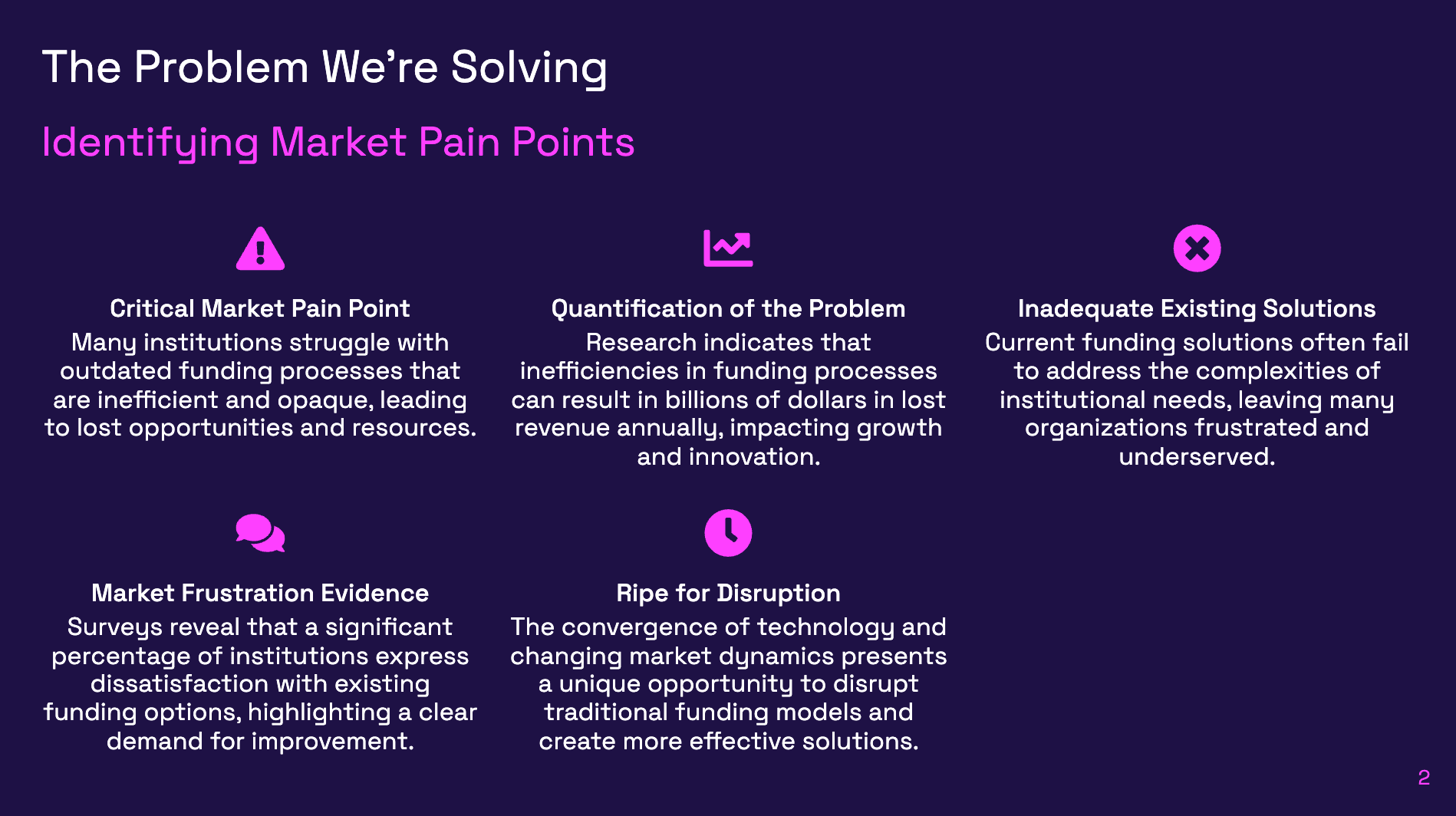
Slide 4 - The Problem We're Solving
A startup should solve a real world problem. The interesting part is that the problem in many cases is not obvious to most people. Usually it's a technological advancement, a change in government regulations, a change in consumer behavior or a change in industry standards, etc. that sparks a new opportunity. Make the problem (inefficiency, pain point, etc.) very clear to your audience.
Also, make sure you have actual domain expertise in the problem you're solving. If you don't you might not actually be seeing the problem correctly.
On this slide you can describe the problem in more detail, like pain points of customers, inefficiencies in the industry, inadequate b2b or b2c solutions, and so on.
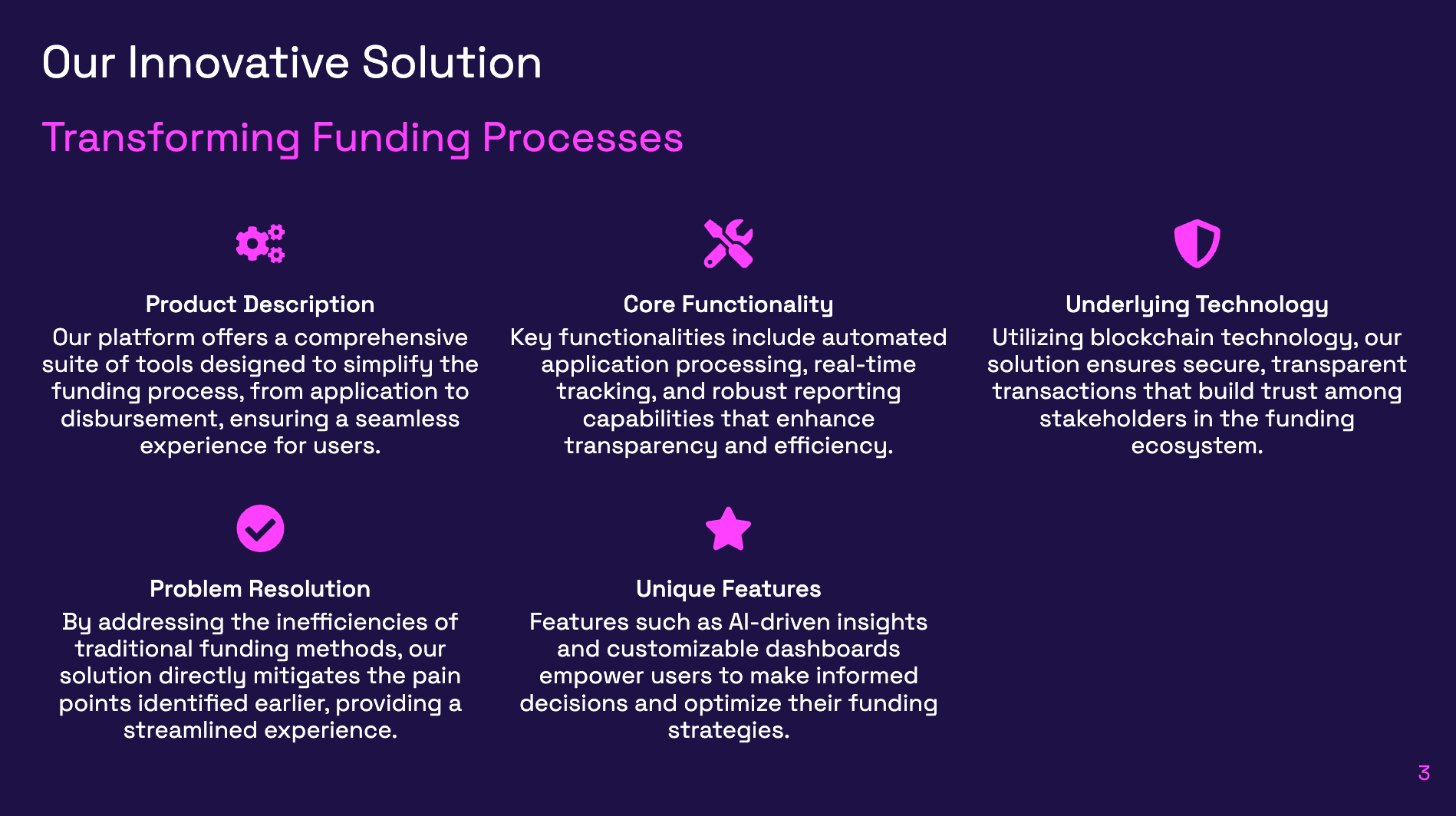
Slide 5 - Our Innovative Solution
You need to convince your audience or investor, that your solution is the best (or at least very competitive) solution on the market, if not the only solution. Do you have a MOAT? Describe it in a few sentences. A MOAT is your unfair advantage, USP, core, and whatever literature calls it. In general, it is what you have and others cannot copy easily, like IP, patents, a network effect as a first mover, a very strong brand, exclusive partnerships or regulatory barriers.
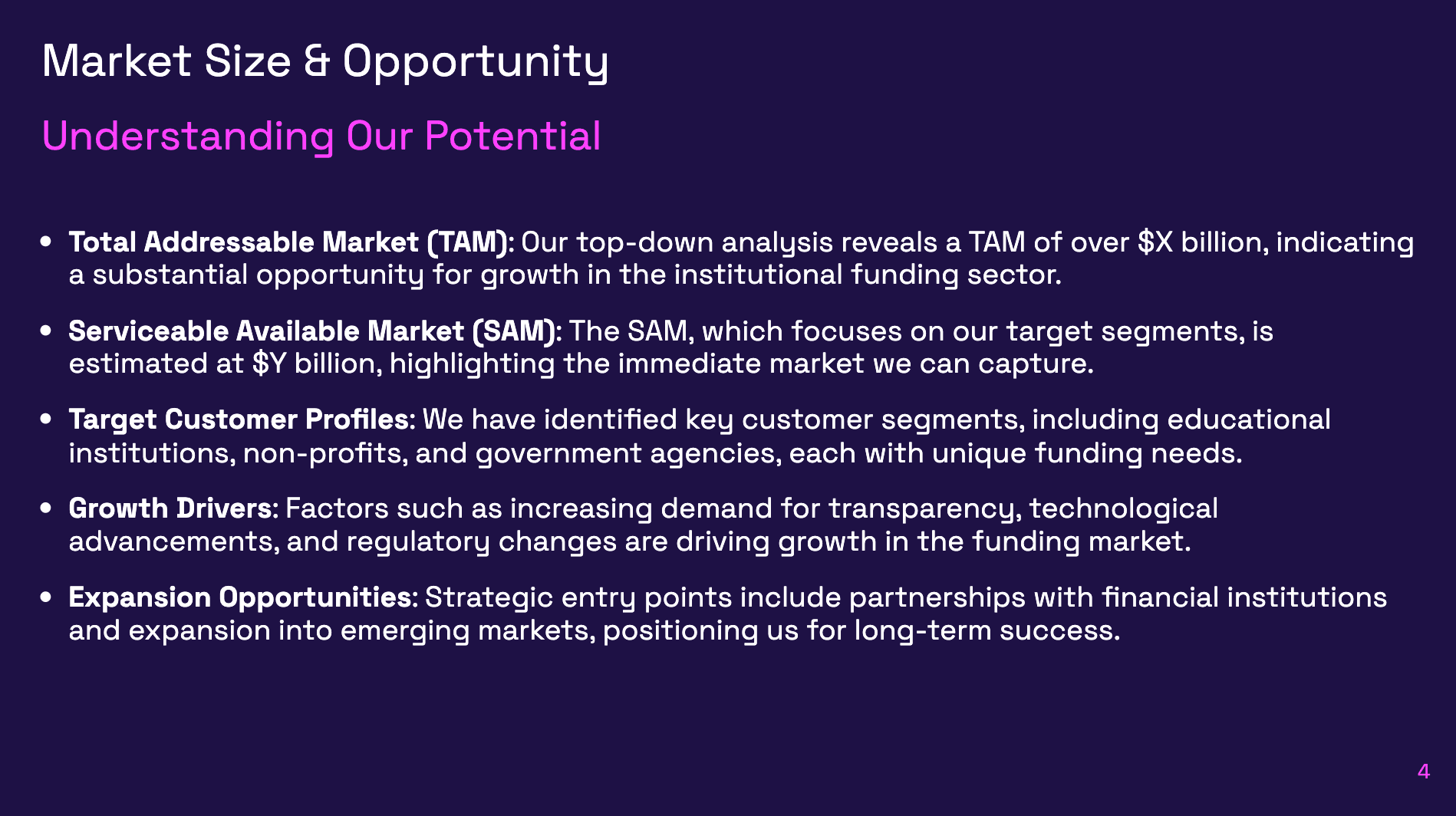
Slide 6 - Market Size
Depending on whether you want to become a 1M, 10M, 100M or 1B company, you need to show investors different market sizes. Obviously, the bigger the market the bigger potential for growth and revenue. But also, you'll have much stronger competition. Make sure you do proper research, and back up your slides (i. e. claims) with data and references. Also, it makes a lot of sense to make sure the market you're in grows. CAGR is usually a good metric to show, it stands for Compound Annual Growth Rate.
In essence, what you'll be showing on the slide: TAM (Total Addressable Market - the entire market demand), SAM (Serviceable Addressable Market - the segment you can reach), and SOM (Serviceable Obtainable Market - what you can realistically capture). Also show the CAGR to demonstrate market growth. We recommend showing the growth of the market over time, and, if available, the market size in different regions, like the US, Europe, Asia, etc. Additionally, highlight why NOW is the right time - what market trends, technological changes, or regulatory shifts create an opportunity for your startup.
Slide 7 - Business Model
How is your startup going to make money? That's, of course, one of the most important questions you need to answer. Will you be selling a product to consumers, a service to businesses, offer subscriptions, etc. It's of great benefit to take a look what similar startups are doing. For example, a lot of startups in the 2010s introduced a so called freemium model, where you offer a free version of your product. Once users were locked in they were upgraded to a paid version. In the 2020s, in times of AI, users were locked into free accounts first. Then, they were offered token based subscriptions to better reflect the cost of using AI.
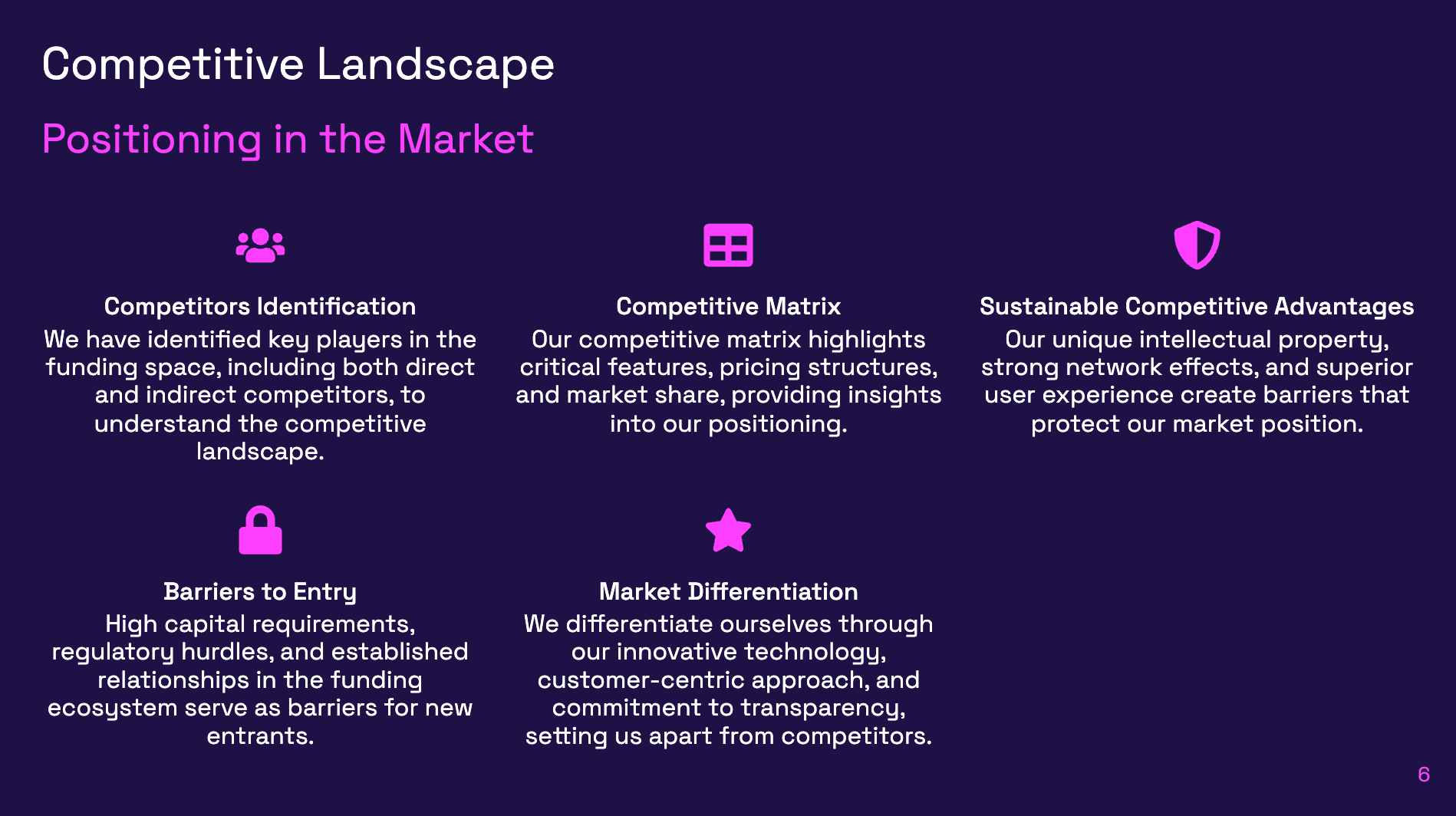
Slide 8 - Competitive Landscape
Are you aware of your competitors? At the beginning, you might only see the surface of your competition. But be aware, that your competition is usually not sleeping. If there is a (big) market and proper growth, there are competitors, more than you probably think. Keep this slide up to date and know where your competitors are moving. There are several ways to show or depict your competitors. You can, for example, show a list of competitors, their market share, and competitive advantage.
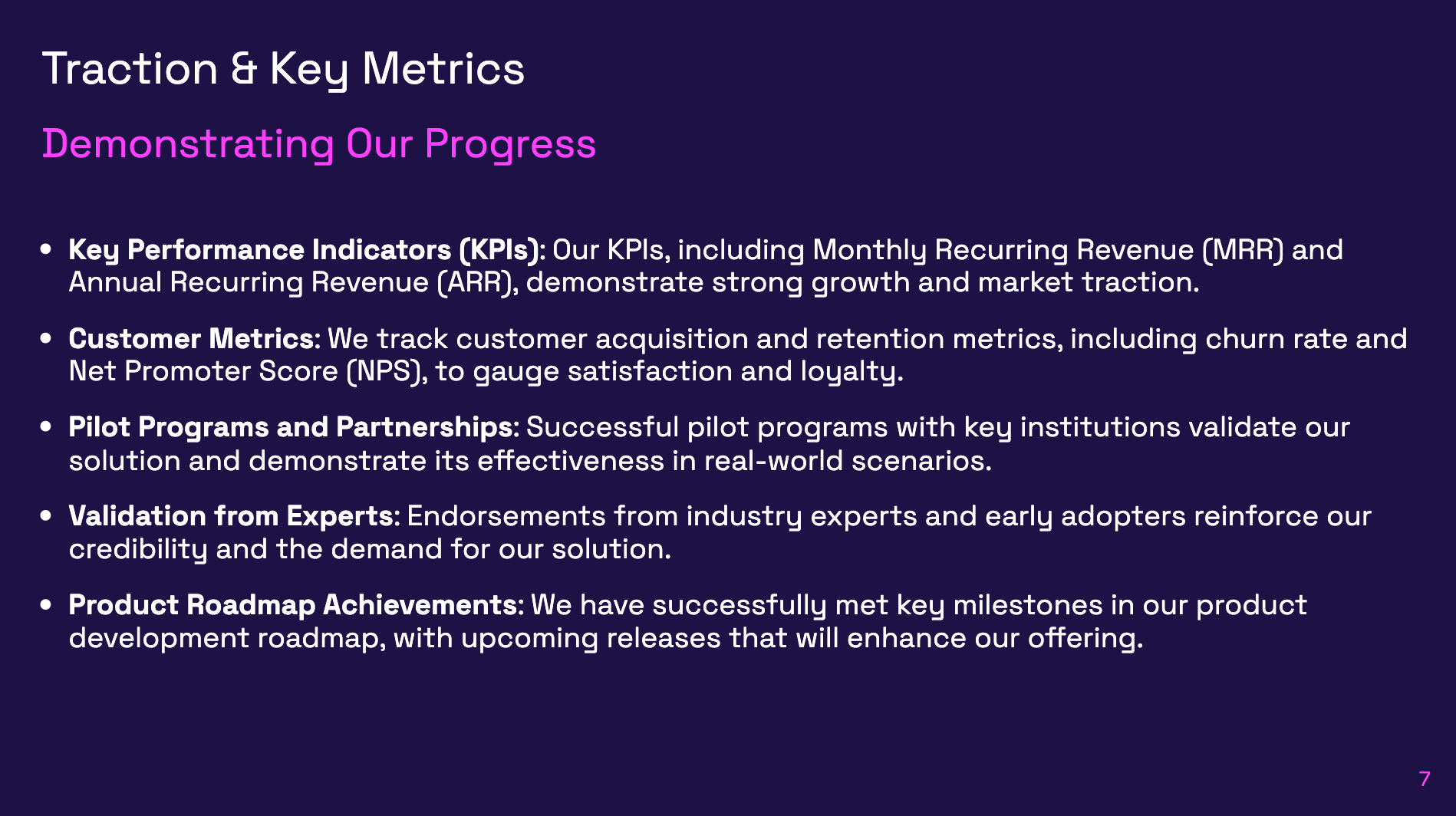
Slide 9 - Traction & Key Metrics
If your startup is in seed stage, you might not have much traction. Some startups raise money only with an idea. But the startups raising money pre-revenue usually have exceptional teams who performed well in previous startups. If there is no revenue yet, you need to at least show letters of intent from potential b2b customers, signups for your product or service (b2c), or other evidence that your startup is working.
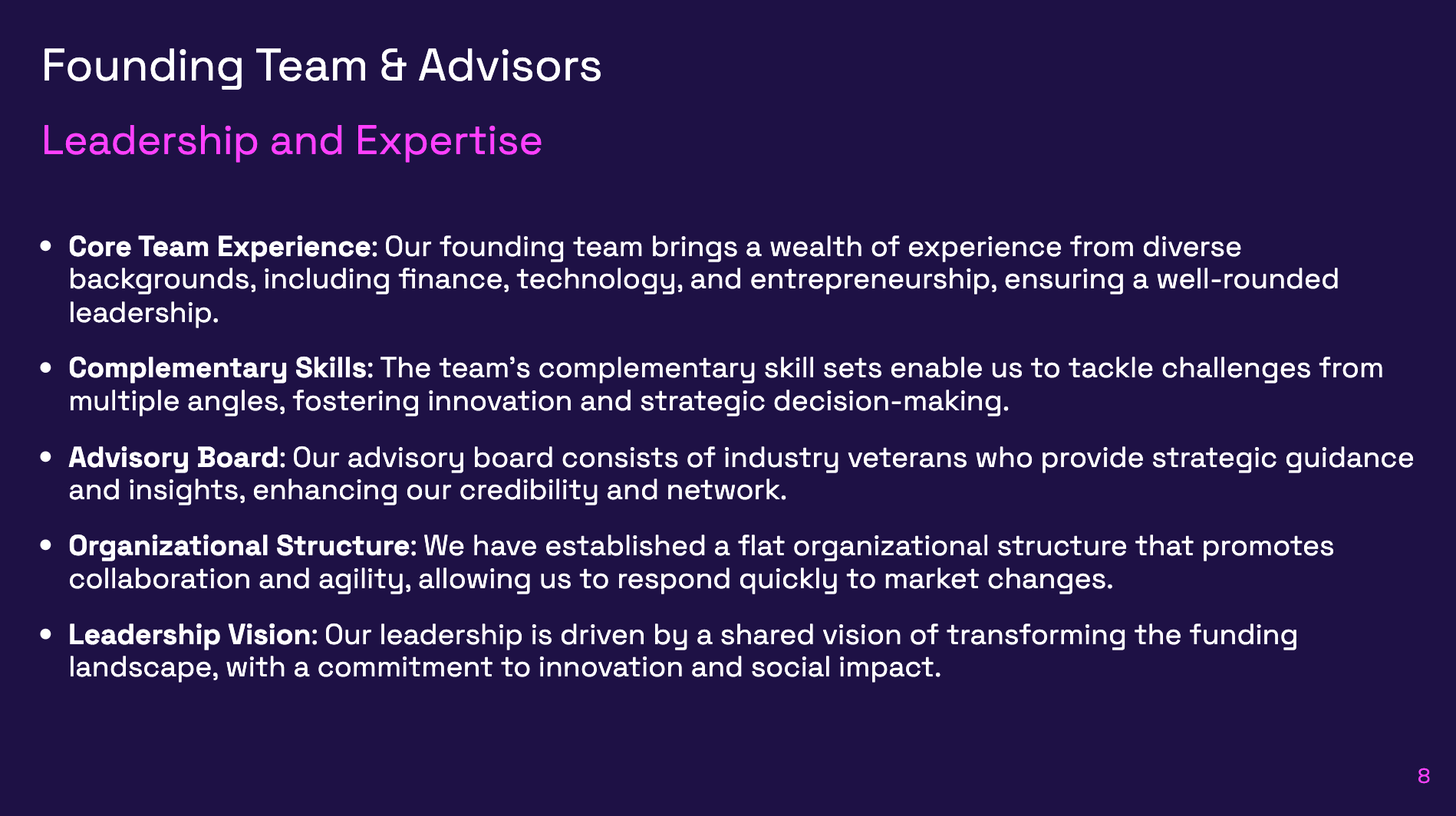
Slide 10 - Founding Team & Advisors
In seed stage, the founding team is of core importance. Show, that you have exceptional expertise in the domain you're in. Also show, that you have team members with complementary expertise, like sales, marketing, engineering, design, etc. If you have advisors filling blind spots, show them. You need to convince the investor that they're investing in the right team. Also, startups need to pivot at some point in time. Only with the right team, you can pivot successfully.
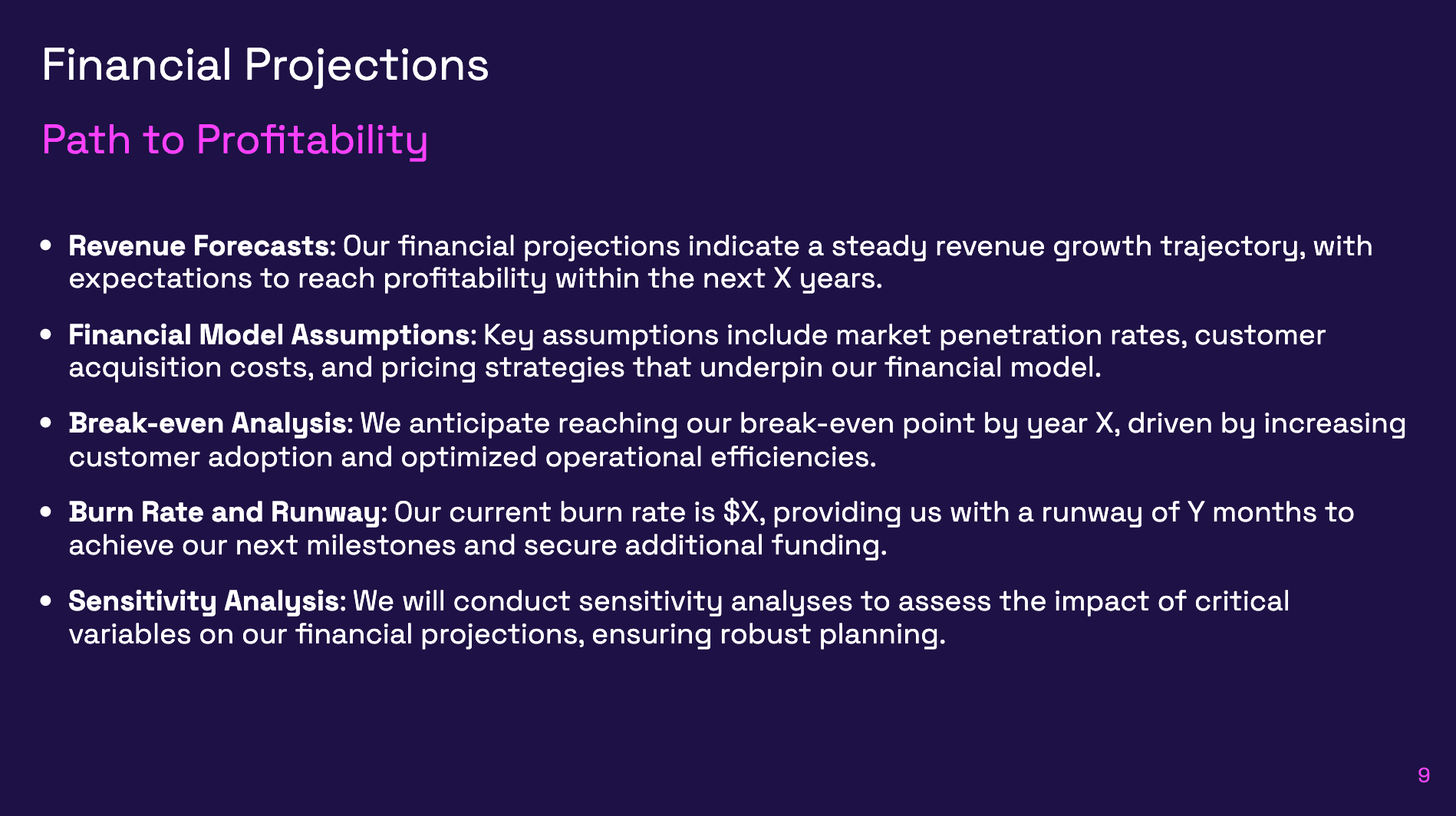
Slide 11 - Financial Projections
How much revenue can be expected in the next 3-5 years? While projections involve assumptions, investors expect well-reasoned forecasts based on your business model and market data. Show that you understand what you'll do with the funds you're raising. What do you need money for? Where will your money go? Do you need a salary for the founders, or is it a lean startup?
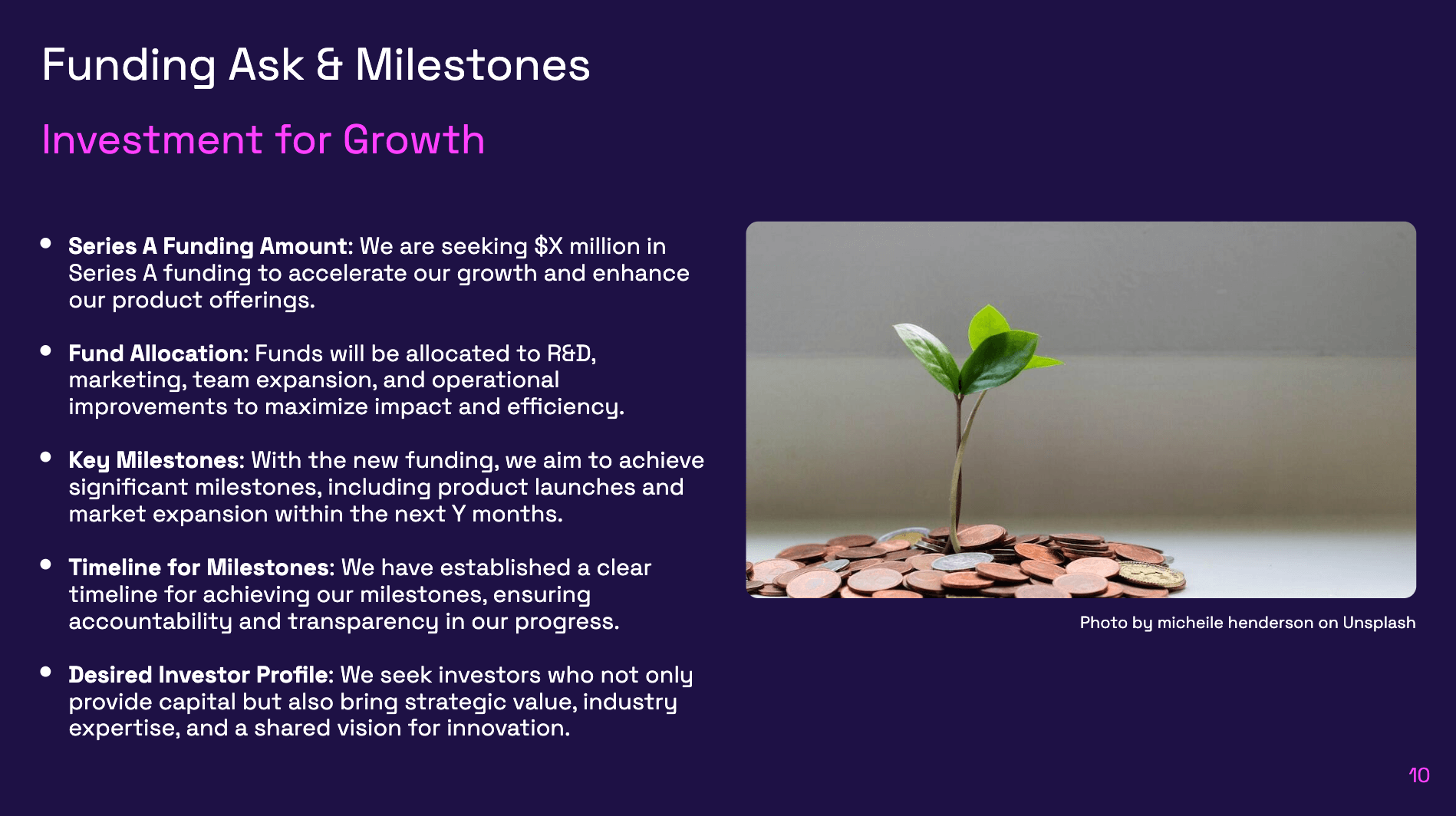
Slide 12 - Funding Ask
State clearly and confidently the exact amount you're raising. Calculate carefully to ensure you have sufficient runway, typically 12-18 months. You don't want to be asking for additional funding shortly after closing this round. Make sure you do the right math to have adequate runway.
Break down your use of funds with allocations, e.g. 40% engineering, 30% marketing, 20% sales, 10% other. Also address your startup-valuation as it is very important. Your investor will receive a share of your company based on the invested amount and to the company's valuation.
Conclusion
Remember that your pitch deck is a storytelling tool. In the end, investors are humans after all. And they need to trust you.